


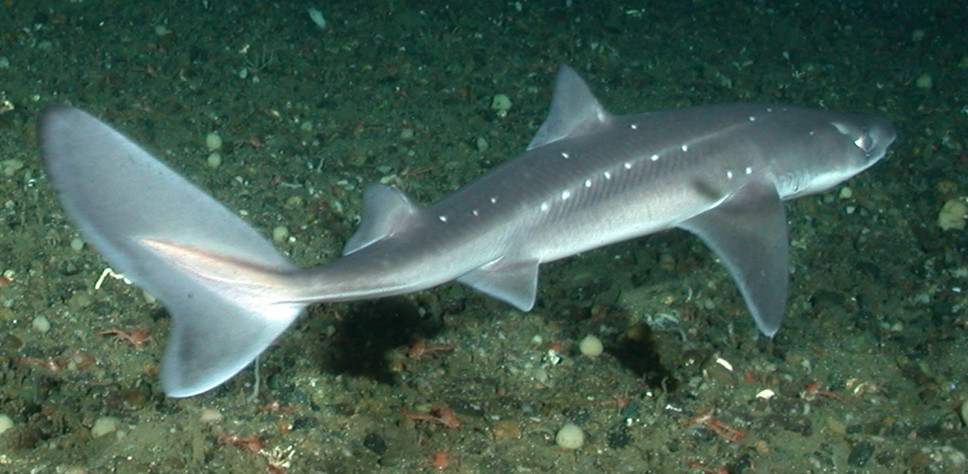
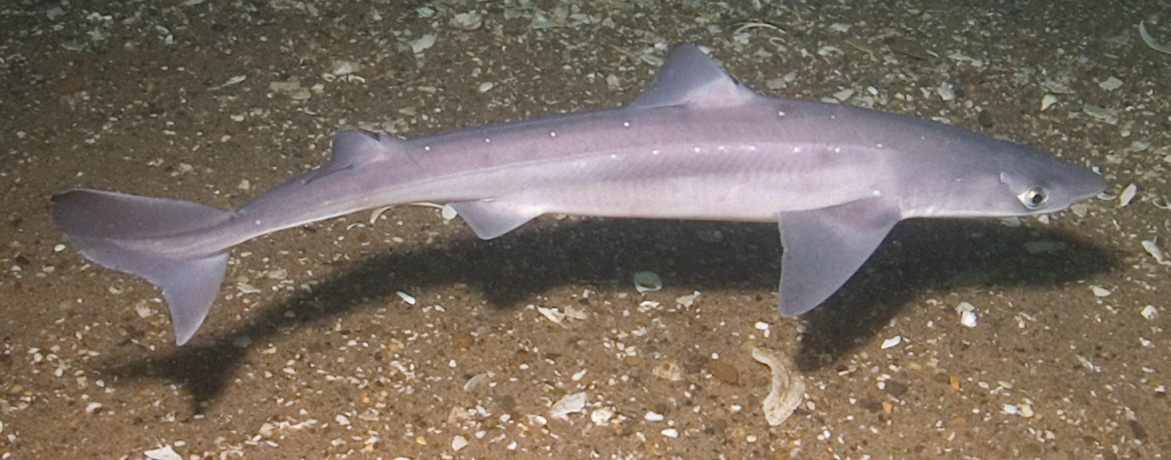
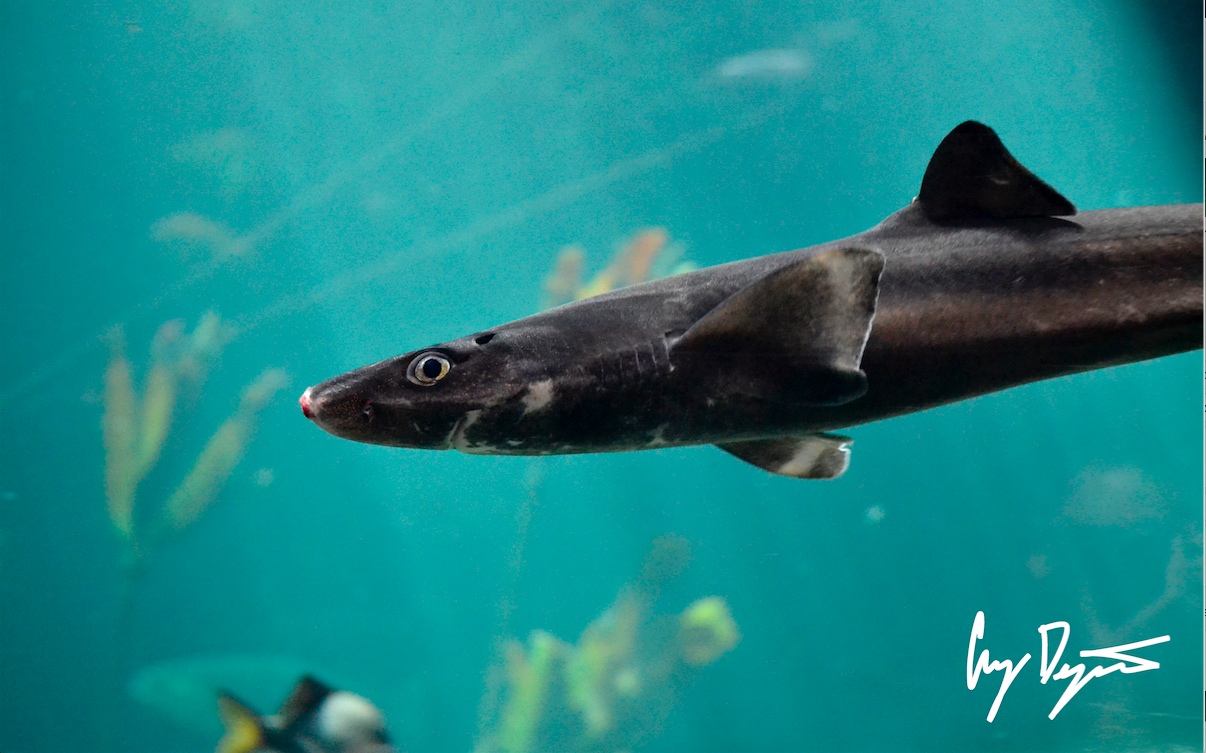
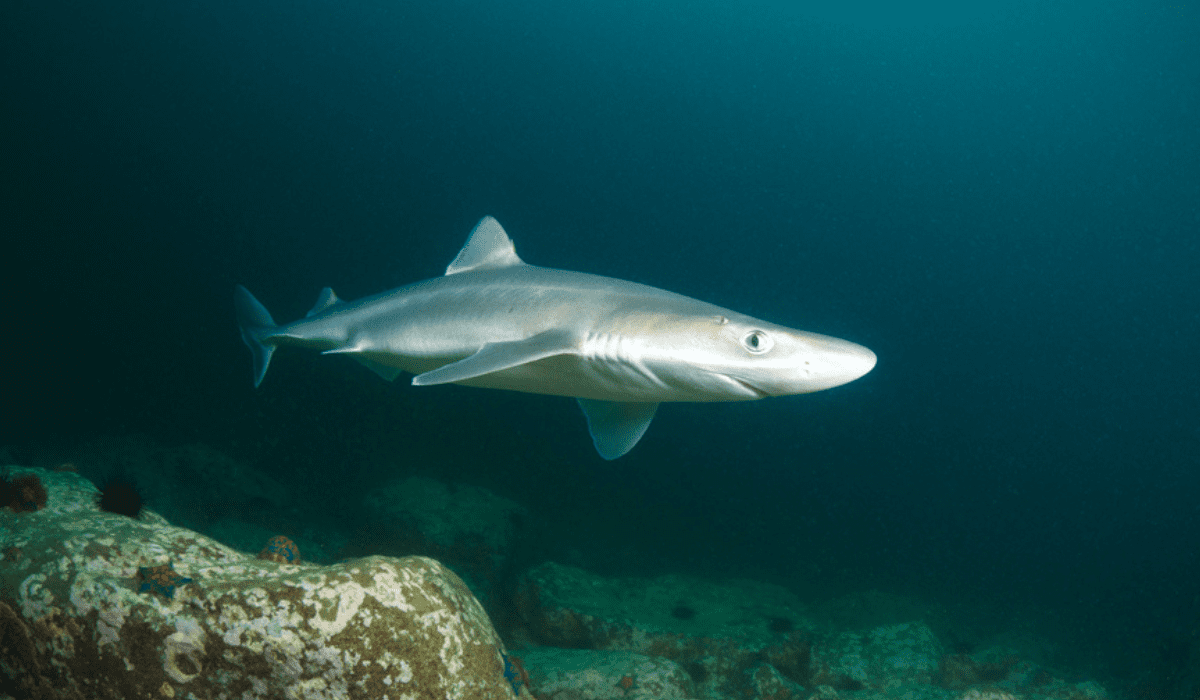
The Spiny Dogfish is found all over the world in temperate and sub-arctic waters and occasionally in the Mediterranean and Black seas. Despite the fact they were once the most populous shark in the world, the population has gone into sharp decline, primarily due to overfishing in Europe. They are commonly eaten in France and Germany and can be found in the Fish and Chip shops of Britain.
The Spiny Dogfish take their name from the mildly poisonous spines found on their dorsal fins. They can arch their back and use these spines as a defence mechanism against predators. They are estimated to live for up to 100 years and also have the longest gestation period of any known animal. It takes nearly two years to produce a litter averaging 6 or 7 pups.
As with many species of shark, females tend to be larger and reach sexual maturity at a later age. In the Spiny Dogfish, males grow to an average of 90cm/3 ft and reach maturity at 11. Females grow to between 98 and 159cm/3.2–5.2 ft and mature between 18 and 21 years. They travel in large schools, separated by sex and size and were apparently dubbed dogfish by the fisherman who observed them hunting their prey in ‘packs’.
Historically, the species has been intensively fished across most of its range, taken as targeted and incidental catch by hand line, demersal gillnet, trawl, dredge, and longline in artisanal, industrial, and recreational fisheries. Its distribution overlaps with intensive fishing activities while its aggregative behaviour increases its catchability. The large-scale, targeted fishing pressure that led to overfishing of the North Atlantic stock has decreased markedly, although incidental catch in multi-species fisheries continues. Retention bans have been implemented in the European Union. In the Northeast Atlantic, considerable stock recovery has been achieved through long-term, science-based catch limits. In the South Pacific, New Zealand has a long history of managing Spiny Dogfish fisheries through quotas. Elsewhere, management measures are lacking. Given the history of Spiny Dogfish depletion that has taken decades of management to address, as well as the species’ inherent susceptibility to incidental capture and overfishing, precautionary, stringent management is advised for all stocks. Globally, the population of Spiny Dogfish is estimated to have reduced by 30–49% over the last three generations (51 years), based on abundance data and levels of exploitation, and the species is assessed as Vulnerable A2bd.
The species is used extensively for its flesh, fins, and liver oil, with most Atlantic products destined for the European Union (EU) market (Dell’Apa et al. 2013). In the Pacific, catch from New Zealand is used domestically, as well as exported to other countries, including Australia and South Korea (e.g., Seafood NZ 2018).
The Spiny Dogfish is subject to species-specific management action across much of its range. North Atlantic populations that have been seriously overfished are now protected by strict science-based catch limits that have so far resulted in significant rebuilding off the United States (e.g., ICES-WGEF 2018). Given the species’ sensitive life history, susceptibility to incidental capture, and persistent market demand, management programs should be continued and expanded to other regions to ensure recovery of stocks and sustainability over the long-term.
In the Northeast Atlantic, a maximum landing length of 100 cm was introduced in European Union (EU) waters (including the Mediterranean) in 2009 to deter the targeting of mature females. The Spiny Dogfish Total Allowable Catch (TAC) for EU Member States reporting to ICES was reduced by 90% in 2010, and set to zero in 2011 (ICES-WGEF 2018). In 2011, the EU prohibited targeting, retaining, transshipping, and landing Northeast Atlantic Spiny Dogfish for all EU and third country vessels in EU waters of ICES areas 2, 3, 4, 5, 6, 7, 8, 9 and 10; discards above 50 kg are to be reported (Shark Trust 2019)
In the Northwest Atlantic, Spiny Dogfish catch limits have been established by both U.S. and Canadian fisheries management agencies under separate actions (no bilateral management agreement exists). In the U.S., Spiny Dogfish fisheries are jointly managed by the Mid-Atlantic and New England Fishery Management Council, in conjunction with the Atlantic States Marine Fisheries Commission (ASMFC) (NOAA 2019). In 2000, the federal Spiny Dogfish Fishery Management Plan (FMP) established science-based commercial quotas and trip limits, initially implemented to end the targeting of pregnant females. State shares of the annual commercial quotas are allocated through the ASMFC. Recreational take is a minimal component of fishing mortality; access to the fishery is not limited, but a permit is required to fish in federal waters
here are a number of chondrichthyan-specific management actions that may indirectly benefit the Spiny Dogfish, including retention bans, area closures, and move-on rules when chondrichthyans exceed 30% of a vessel’s catch in a fishing event.
In the Southwest Pacific, the Spiny Dogfish is managed in New Zealand through annual Individual Transferable Quotas (ITQs) since 2004. The species is also listed under Schedule 6 of the Fisheries Act, which allows fish to be returned to the sea if they are likely to survive upon return, and that the return takes place as soon as possible (FNZ 2019).
The Northern Hemisphere population of Spiny Dogfish is listed on Appendix II of the Convention on the Conservation of Migratory Species of Wild Animals (CMS) and Annex I of its Migratory Sharks Memorandum of Understanding (CMS Secretariat 2019). Through these listings, CMS Party Range States have committed to collaborate toward regional conservation, but no specific actions have been agreed under CMS since the listing in 2008.
Do you have images or videos of Spiny Dogfishs?
Submit them to [email protected].



Donate Now | Team Sharkwater Newsletter | Group Sales | Shark Database | #SharkFree
Contact Us | Press | Partners | Terms of Use | Privacy Policy
© 2026 Sharkwater Productions - The Truth Will Surface 🦈