


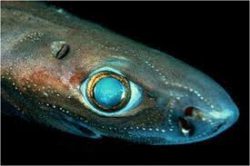
The splendid lanternshark is a species of dogfish shark found in the Western Pacific, with known populations in Japan, Taiwan, New Caledonia, and Vanuatu. It has been caught at depths of 120 to 210 m/394–689 ft, and there are reports of them at depths of up to 730 m/2,395 ft.
Like all lanternsharks, they’re small deep water sharks known for the light-producing photophores on their bodies. The photophores are concentrated mostly on their belly and it works as counter illumination, making the shark seem brighter to match their backgrounds. This makes it easier for the lanternshark to stalk prey. They feed on small squid and other invertebrates.
They’re presumably ovoviviparous and reach a maximum length of 30 cm/ 11.8 in. Ovoviviparous animals reproduce by developing eggs inside the mother’s body, where the embryos hatch internally and are born as live young, nourished by the egg yolk rather than a placenta.
This species is taken by demersal trawl fisheries and retained for fish meal and possibly liver oil. It is rare in Japan and abundant in Taiwan. The small size of the species may reduce its catchability. In Japan, bottom trawl fishing effort has decreased markedly over the last three decades and is continuing to decline. Over the past 30 years, the deep-water trawl fishery in eastern Taiwan has moved deeper for most of the year from 100–300 m to 300–700 m deep; the Splendid Lanternshark would still be captured at 300 m but most of the fishing pressure is deeper and beyond the depth range of the species, which would provide some refuge from fishing pressure in that area. The Taiwan ban on trawls within 3 nm of the coast may also provide refuge from fishing. There has been little change to the landing rates of this species over the past 31 years, which infers a stable population as fishing effort has remained relatively stable. There is no evidence of population decline and since the Splendid Lanternshark is not suspected to be close to reaching the population reduction threshold, it is assessed as Least Concern.
No specific measures are in place. In Taiwan, since 1999, all demersal trawling is prohibited within 3 nautical miles (nm) of the coast and within 12 nm for trawlers larger than 50 Gross Registered Tonnage (Fisheries Agency 2019, Liao et al. 2019). In Japan, management measures have been implemented since the mid-1990s to control fishing effort that include total allowable catches, seasonal closures, and gear restrictions (White Paper 2015). Research is needed on population size and trend, and life history, and catch rates should be monitored.
Do you have images or videos of Splendid Lanternsharks?
Submit them to [email protected].


Donate Now | Team Sharkwater Newsletter | Group Sales | Shark Database | #SharkFree
Contact Us | Press | Partners | Terms of Use | Privacy Policy
© 2026 Sharkwater Productions - The Truth Will Surface 🦈