


The Spongehead Catshark is a rare species of deep-sea catshark, belongs to the family of Scyliorhinidae. Found mainly in the Pacific Ocean.
Biology and Description:
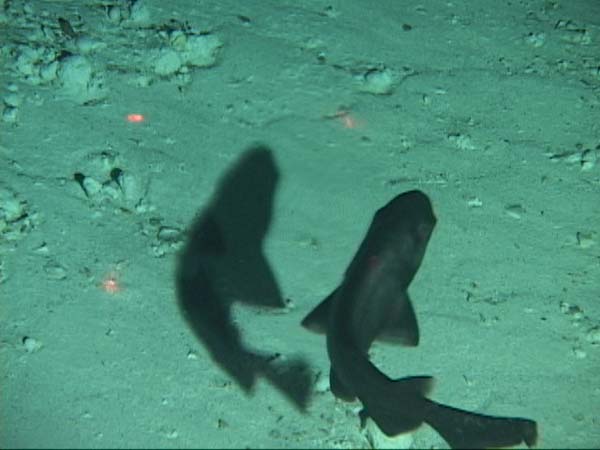
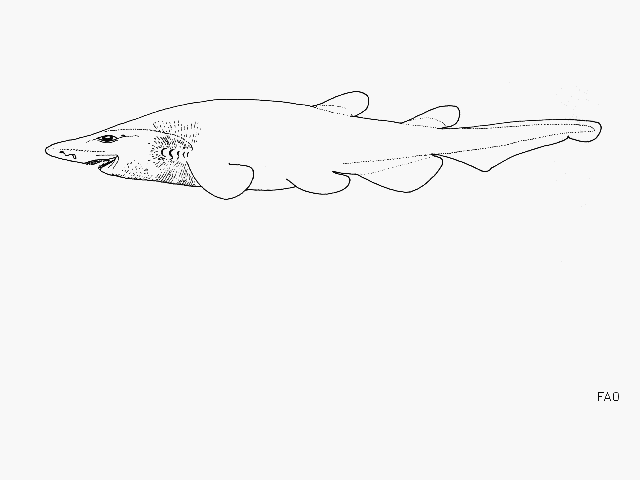
The Spongehead Catshark has a thick body and head, with a moderately long, broadly rounded snout. The five pairs of gill slits are very small as well as the eyes. The nostrils are broad with unique pleats and folds that extend above and below the throat. The two dorsal fins are about equal size; the pectoral fin is rather small while the pelvic fins are large and round. It is of dark brown colour with no fin markings. Adult species measure 51.4 cm/1.69 ft TL and juveniles measure about 10.5 cm/4.1 in TL. The Spongehead belongs to the A. spongiceps species characterized mainly by their short and wide snout. They are oviparous, with one egg per oviduct. Paired eggs are laid and embryos feed solely on the yolk.
Habitat:
This species is bathydemersal and their distribution ranges from 572 – 1482 m/1,877–4,862 ft deep. They occur around the insular slopes or near the bottom. Found in the Banda Sea off southern Sulawesi and the Hawaiian Islands.
Conservation:
Threats to this species are unknown. No conservation measures are currently in place for this species.
The species occurs beyond the depth of current fisheries in its range and was outside the spatial range of historic fisheries. It occurs within a Marine Protected Area and mostly within a Marine Refuge where all fishing is prohibited. It is unclear if the photographed individual occurred within the Marine Reserve; however, it inhabited a rocky area with high relief, which provides refuge. In 2022, the Hawaii shark protection went into effect and all sharks caught in Hawaii state waters must be released. There are currently no interactions with fisheries and thus, nothing to infer or suspect population reduction at this time and the Spongehead Catshark is assessed as Least Concern. If further specimens are recorded outside of its current range or future fisheries extend into the species depth range, this assessment should be revisited.
There are no species-specific conservation measures. The range of this species is within the Papahānaumokuākea Marine National Monument (Monument) that covers waters in the northwest Hawaiian archipelago. Within the larger Monument area, Nihoa Island and most atolls, are included in the Northwestern Hawaiian Islands Marine Refuge that includes waters extending three nautical miles of any coastline (excluding Midway Atoll) and prohibits all taking of marine life. This species would thus receive significant protection from fishing. A prohibition on deep-sea mining in Hawaii state marine waters came into take effect in July 2024. In 2022, the Hawaii shark protection act went into effect, making it illegal to knowingly capture, entangle, or kill any shark species in state marine waters and consequently, all sharks caught in Hawaii state waters must be released. Further research is needed on distribution, population size and trends, and life history, and catch rates should be monitored if there are any catches.
Do you have images or videos of Sponge-head Catsharks?
Submit them to [email protected].


Donate Now | Team Sharkwater Newsletter | Group Sales | Shark Database | #SharkFree
Contact Us | Press | Partners | Terms of Use | Privacy Policy
© 2026 Sharkwater Productions - The Truth Will Surface 🦈