


The Carcharhinus Sorrah shark, also known as the Spot-tail Shark, is a species of requiem shark, belongs to the family Carcharhinidae and is found in the tropical Indo-West Pacific ocean.
Biology and Description:
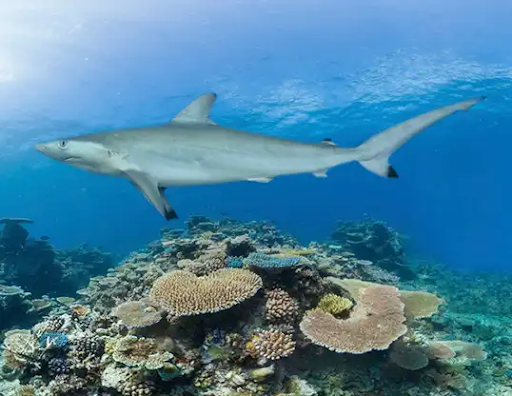
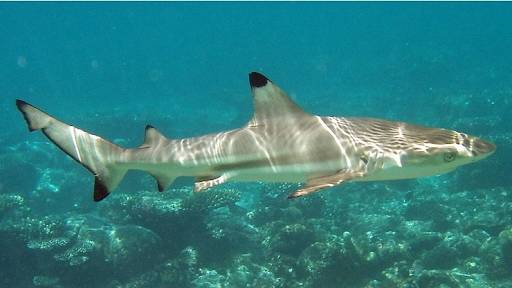
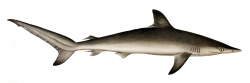
The Spot-tail shark is a small, spindle-shaped shark with a long, rounded snout, large circular eyes, and oblique-cusped serrated teeth. The first dorsal fin is large and curved while the second dorsal fin is small and low. The back and sides are grey and the belly white, and there is a long white streak on the flank. The upper teeth are serrated, oblique and triangular. It lacks the ridge between the two dorsal fins and its upper are also different, being slender, upright and pointed.
This species is viviparous with a yolk sac placenta, giving birth once a year to a litter of one to eight live young. The gestation period is ten months and the pups measure about 50 cm/1.64 ft at birth. Males reach maturity at 90 cm/2.95 ft TL and females at 95 cm/3.12 ft TL.
Habitat:
The Spot-tail shark is a common inshore shark on continental and insular shelves found from close inshore to a depth of at least 140 m/459 ft. Common over mud and sand bottom in depths between 20-50 m/66–164 ft but also occurs near coral reefs. It also occurs throughout the water column but mainly in midwater or near the surface. Young prefer very shallow, inshore waters. Its range extends from the East African coast, Madagascar and the Red Sea to India, Malaysia, China, the Philippines and northern Australia.
Conservation:
The Spot-tail shark is captured as both a target species and as bycatch in northern Australian shark, finfish and prawn fisheries, although current catch rates are highly unlikely to threaten the Australian population. There are currently no conservation actions in place through much of its range. Fisheries catching this species in northern Australia are relatively well managed and reporting of catches is good.
This is among the most productive of sharks with fast growth rates, early maturity, and moderate fecundity, suggesting that this species is more resilient to exploitation relative to most other shark species. It is caught as target and bycatch throughout its range in industrial and small-scale fisheries using longline, gillnet, handline and demersal trawls, and is retained for its meat, fins, skin, teeth and liver oil. It is often one of the species most commonly still caught in coastal gillnet and longline fisheries throughout southern and south-east Asia, and Australia. Limited species-specific data is available on the population trend, but carcharhinid sharks throughout much of the region have declined due to the intensive level of fishing pressure. In northern Australia, the species has recovered from historic overfishing and is currently sustainably fished, providing some refuge for the species. While the Spottail Shark’s high productivity allows it to sustain higher levels of fishing mortality than many other species, there are reports that its abundance has declined in areas with very intensive fishing. Therefore, the Spottail Shark is suspected to almost meet decline criteria and is assessed as Near Threatened, close to meeting the criteria for Vulnerable A2d.
Very few specific conservation measures are in place for the Spottail Shark over much of its range except Australia. All Australian fisheries that target the Spottail Shark are managed. Catch is controlled by input (restrictions on entry to the fishery, effort, gear, and area that can be fished) and output (Total Allowable Catch (Queensland) or Individual Transferable Quotas (Northern Territory)) controls. Management measures maintain catches below levels that will maintain stocks at sustainable levels (Simpfendorfer and Dulvy 2017). Recreational catches of shark are restricted by bag limits, possession limits, and gear restrictions (Johnson et al. 2018). Due to its importance as a commercial target species, in Australian waters the Spottail Shark has been relatively well studied and as a result its biology and response to fishing pressure is well understood. The effect of Illegal, Unregulated and Unreported (IUU) fishing in Australian waters remains uncertain, but it is suspected that levels have decreased since a peak in the mid-2000s in response to increased border patrols, along with other factors such as the increase in fuel prices and decrease in shark fin prices (Marshall 2011).
There are no other species-specific conservation measures in place in the remainder of its range. However, a number of nations have banned targeted fishing for sharks (e.g. Sudan, Saudi Arabia, Egypt, Kuwait, Maldives), but incidental catches occur in non-target fisheries. Some countries also have bans on specific fishing gears that benefit this species (e.g. United Arab Emirates (UAE), Qatar, and Oman have banned trawling in their waters). However, incidental catches occur in other fisheries (e.g. gillnetting) to which they are more susceptible. India and UAE banned all shark fin export in 2015. Shark finning has also been banned in the UAE, Oman, Iran, India, and Sri Lanka yet trade surveys indicate that some trade in the fins and meat of this species still occurs. Spottail Sharks likely also benefit from the numerous Marine Protected Areas that occur throughout its range. However, no data are available to estimate the benefits they provide, or whether they have reduced population declines. Further research is needed on population size and trend, and life history, and catch rates should be monitored.
Do you have images or videos of Spot-tail Sharks?
Submit them to [email protected].


Donate Now | Team Sharkwater Newsletter | Group Sales | Shark Database | #SharkFree
Contact Us | Press | Partners | Terms of Use | Privacy Policy
© 2026 Sharkwater Productions - The Truth Will Surface 🦈