


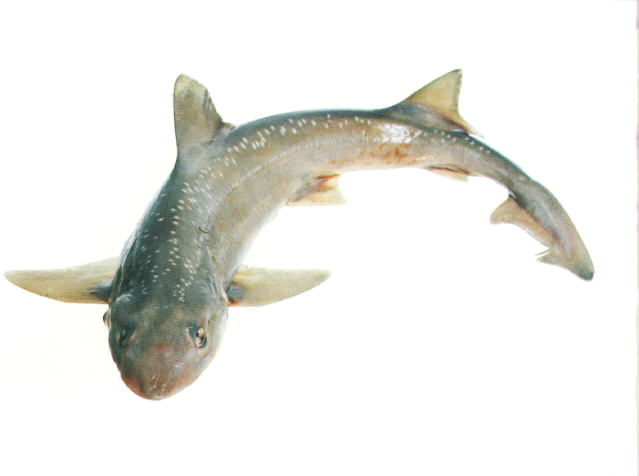
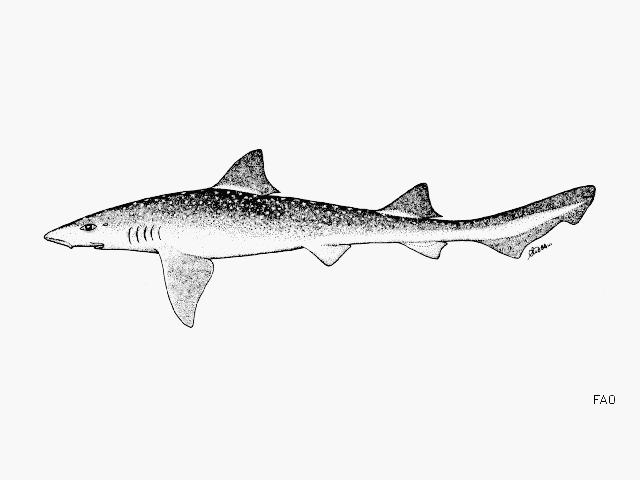
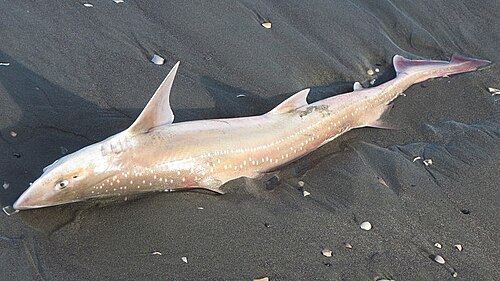
Spotted estuary smooth hound, also known as rig, are deepwater medium sized sharks that are endemic to New Zealand in the southwest Pacific Ocean at depths of zero to 860 m (2,822 ft), but usually from zero to 400 m (1,312 ft).
Biology and Behaviour
Spotted estuary smooth hounds are grey in colour and have a pointed snout. They make seasonal inshore-offshore migrations. They form schools that are separated by size and gender. They feed on crustaceans, mainly crabs and sometimes echiurans and molluscs.
Reproduction and Lifespan
Spotted estuary smooth hounds are a fast growing species and mature at the age of seven or eight years.
They are ovoviviparous and females give brith between two to 37 pups with a gestation period of about 11 months. Young smooth hounds are 20 to 32 cm at birth. Most mature females give birth every year thus leaving females about one to two months between pregnancies.
Males can grow up to a length of 125 cm (4 ft 1 in) and females grow a little longer at 151 cm (4 ft 11 in) , but they are commonly 85 cm (2 ft 9 in). long.
They can live up to 15 years.
Conservation and Tourism
The IUCN lists spotted estuary smooth hounds as least concern. The population for spotted estuary smooth hounds has been stable for the past 17 years and the population trend is currently increasing. The Quota Management System manages the fishing quota for this species.
The species is considered to have a relatively large population size, and analysis of catch-per-unit-effort (CPUE) in each management area suggests the overall Rig population is stable. Rig is fished commercially and recreationally throughout New Zealand, and is taken in benthic trawl, longline, and set nets, and small quantities are also caught by customary non-commercial fishers. There is no evidence of a decline in population, and Rig is assessed as Least Concern.
New Zealand has had a Quota Management System (QMS) in place since 1986 to provide for the sustainable management of its fisheries. Rig has been managed under the QMS, which sets annual Individual Transferable Quotas (ITQs), since 1986. This species is also listed under Schedule 6 of the Fisheries Act, which allows fish to be returned to the sea if they are likely to survive upon return, and that the return takes place as soon as possible (MPI 2013). New Zealand has a system of Benthic Protected Areas (BPAs) and Seamount Closures, however they are unlikely to provide any major refuge for this species given the spatial occurrence of the closed areas (see Black and Tilney 2015). Since 2008, a series of regulations intended to protect Maui’s (Cephalorhynchus hectori maui) and Hector’s dolphins (Cephalorhynchus hectori hectori) were implemented, including set net fishing closures (west coast North Island, east and west coast South Island), and likely offer some protection to Rig (MPI 2017). The flesh of Rig is exported overseas (Clarke et al. 2013), or is sold locally as “lemonfish” (Francis 1998).
Do you have images or videos of Spotted Estuary Smooth-hounds?
Submit them to [email protected].


Donate Now | Team Sharkwater Newsletter | Group Sales | Shark Database | #SharkFree
Contact Us | Press | Partners | Terms of Use | Privacy Policy
© 2026 Sharkwater Productions - The Truth Will Surface 🦈