


The Spotted Houndshark is a large sized shark found in the Southeast Pacific from Peru to northern Chile and around the Galapagos island. It is very rare and hence the biology is unknown. It is usually fished in Peru and Chile with other houndsharks. These sharks are often refered to as ‘tollo’ by the local people and are heavily fished. The fisheries in Peru have stopped catching tollos due to the decline in the number.
Spotted houndsharks are considered vulnerable due to the extensive fishing and high mortality. The biological aspects of this shark are unknown as it has an uncommon population and it becomes difficult to infer its trends based on other similar sharks as they have a declined population as well. However, it has been found that houndsharks are moderately early-maturing and fast-growing.
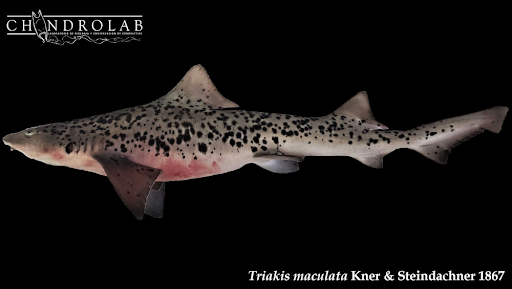
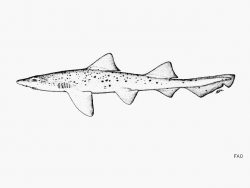
Spotted houndsharks, as the name suggests have black spots on them and generally light gray becoming white on the ventral surface. These sharks reach a maximum size of 180 to 240 cm/5.9–7.9 ft in length. The confirm size and maturity is unknown because of its rare presence. The babies at birth measure up to 30 to 40 cm/11.8–15.7 in and a female could have up to a litter of 14 pups. They are usually found near the reefs and soft bottoms like sand, mud, gravel. They feed on crustaceans which are found on the soft beds.
Local fisheries are shifting away from tollo to allow populations to recover, but until further studies prove otherwise, they’re considered a vulnerable species.
Exploitation is intense in Peru where it is subject to a minimum landing size rule, however, catches of this species are effectively unregulated and the true catch is masked in the aggregate product category of ‘tollo’. Historically, in Peru, landings of tollo were high for a 24-year period between 1966 and 1989, averaging 11,276 t per year and reaching a peak of 25,000 t in 1984. Over the period 1990–2004, there was a substantial drop in landings to an average of 4,806 t, equivalent to 99.3% reduction over three generation lengths. Fishing effort has been rising rapidly in Peru, with a 35% increase in fishers and a 54% increase in vessels between 1995–2005. Peru has one of the largest gillnet fisheries in the world, hence, the decline in catches is most likely to reflect a reduction in population size. The contribution of Spotted Houndshark to tollo landings is unknown, however, this is probably the least common of the three species in this mix and it is large and desirable as food. The slow life history compared to other species included in the tollo landings category and the very steep decline in landings lead to concern that the recent low species-specific landings in Peru reflect a steep historic decline. While there may be some refuge in the Galápagos Islands part of its distribution, given the slow life history of this species, high demand, and the strong likelihood that the population decline has already occurred largely unnoticed, it is inferred that the Spotted Houndshark has undergone a population reduction of >80% over the last three generations (60 years), and it is therefore assessed Critically Endangered A2bd.
This shark occurs in the Galápagos Islands Marine Reserve (Acuña-Marrero et al. 2018), although illegal targeted shark fishing does occur there (Carr et al. 2013, Schiller et al. 2015). Peruvian legal regulation established minimum catch sizes in 2001 of 60 cm TL (Gonzalez-Pestana et al. 2019). Management in the form of catch limits combined with species-specific monitoring is needed in order to ensure the continued presence of this houndshark. Further research is needed on life history and population size and trends.
Do you have images or videos of Spotted Houndsharks?
Submit them to [email protected].


Donate Now | Team Sharkwater Newsletter | Group Sales | Shark Database | #SharkFree
Contact Us | Press | Partners | Terms of Use | Privacy Policy
© 2026 Sharkwater Productions - The Truth Will Surface 🦈