


The Starry smooth-hound shark is a common inshore and offshore shark found on the continental and insular shelves. This species of shark is native to the Northeast Atlantic, found in areas like the British Isles and North Sea to Canary Islands, including the Mediterranean and Mauritania.
Biology and Behaviour:
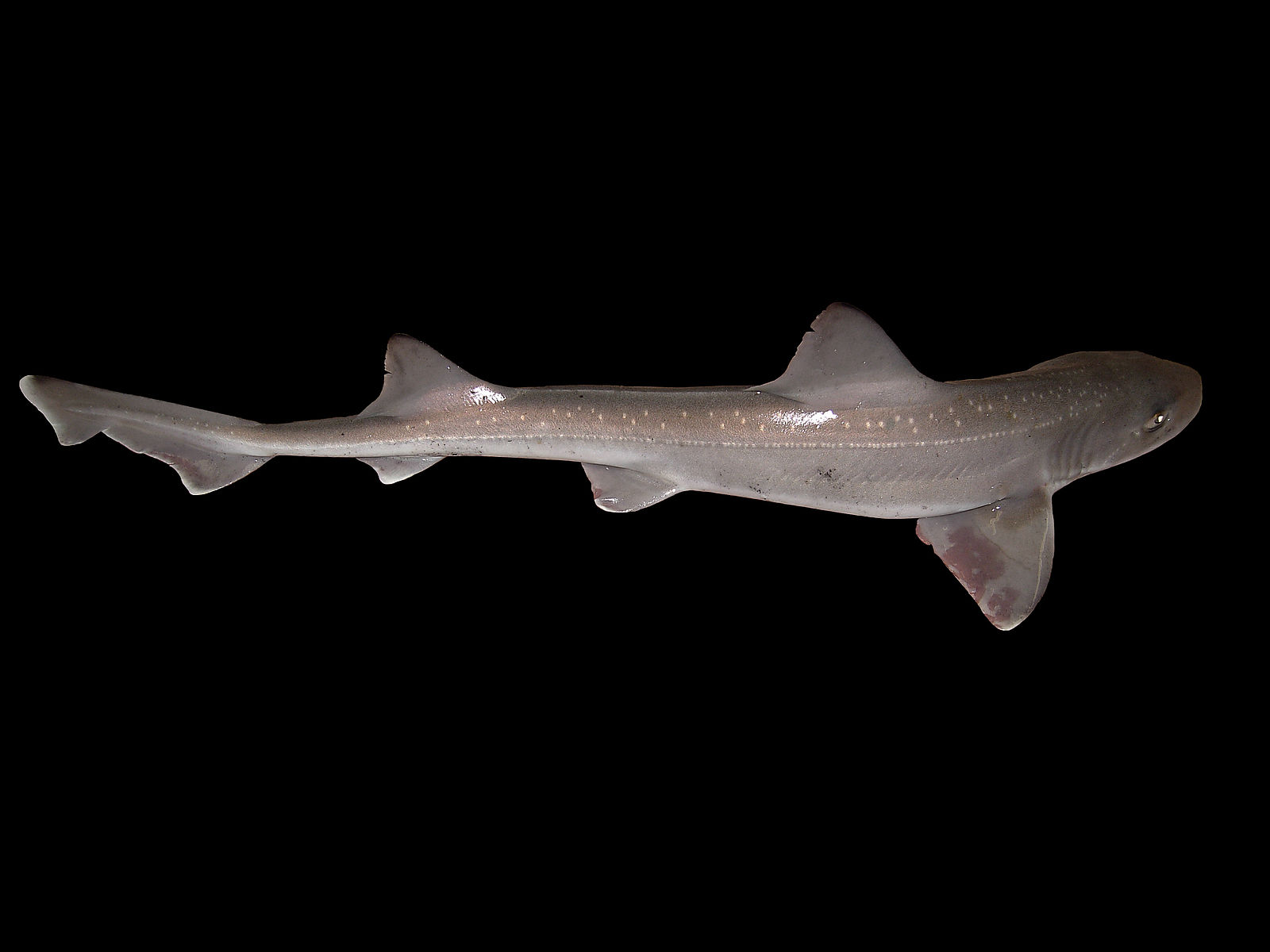
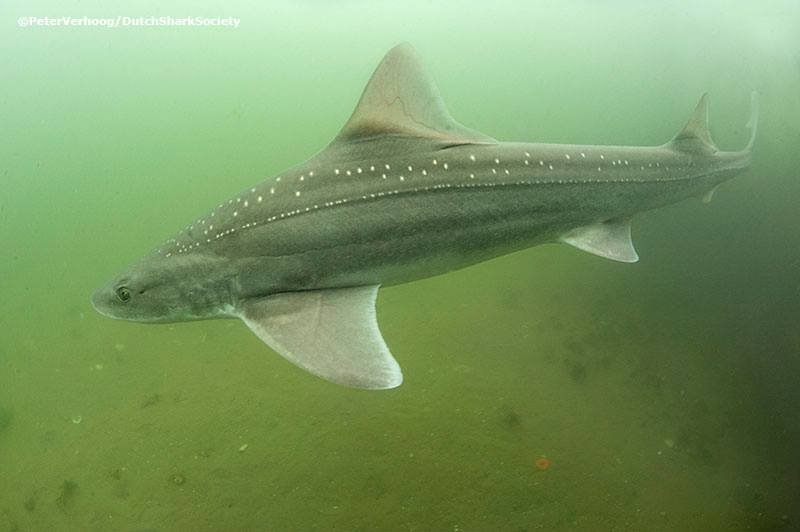
The Starry smooth-hound shark is a small, long, thin shark that can grow up to a max length of 140 cm/4.59 ft and a max published weight of 4.8 kg/10.58 lbs. On the top of this species of shark, around the fin and near the tail the Starry smooth-hound shark has scattered little white dots giving it its name. The Starry smooth-hound shark prefers water with sandy and gravelly bottoms. It can be found at a depth range of 0 – 350 m/0–1,148 ft, and feeds primarily on crabs, lobsters and small bony fish.
Reproduction:
Maturing at around 85 cm/2.79 ft in length, starry smooth-hound sharks are viviparous and give birth to live young. After a 12 gestation period they can have 7 to 15 pups per litter. Pups are born at about 30 cm/11.8 in of length.
Conservation:
In the northern parts of the Northeast Atlantic it has little market value and is often discarded. In the Mediterranean Sea and Eastern Central Atlantic, smoothhounds (Mustelus spp.) are valued for human consumption and are often retained and marketed. No reliable species-specific fisheries catch data are available because landings data often refer to all smoothhounds combined with Tope (Galeorhinus galeus) or spurdogs (Squalus spp.). Abundance trends in fishery independent survey data from Northwestern Atlantic are estimated to be increasing.
In the Mediterranean Sea, abundance trends in fishery independent trawl survey data show that this stock of Starry Smoothhound has been declining in both the Gulf of Lions and the Adriatic Sea over the past 50 years. It should however be noted that the situation in the Mediterranean Sea may be worse than estimated given the grouping of smoothhounds in landings data and consequent masking of species-specific population trajectories. No information is currently available on subpopulation trends in the southern Mediterranean Sea and northwestern coasts of Africa, although the Starry Smoothhound is also caught and landed there in relatively intensive coastal fisheries. Taken together this species is estimated to be increasing in the Northeast Atlantic and inferred to have undergone a population reduction of ~70% % of the past three generation lengths (39 years) in the Mediterranean Sea and Black Sea. Due to similarly high fishing pressure along the continental shelves of the Eastern Central Atlantic it is suspected that this species has also undergone a similar level of population reduction there.
Assuming the Northeast Atlantic region comprises two-thirds of the range of Starry Smoothhound, it is suspected that overall this species has undergone a population reduction of 20–29% over the past three generation lengths (39 years) due to actual levels of exploitation and this species is assessed as Near Threatened (close to meeting Vulnerable A2d).
The Starry Smoothhound is commercially valuable in the Mediterranean Sea and northwestern Africa, where the meat is utilized fresh, frozen, or salted and dried for human consumption. It is regularly present on the Adriatic, Tyrrhenian, Tunisian and Turkish markets; and sold fresh, frozen, refrigerated or salted-dried (Fischer et al. 1987). It is often discarded by commercial fisheries in the Northeast Atlantic, but the species is important for recreational fisheries in some areas of this region.
In the Northeast Atlantic, there is currently no restriction on catch of this species. Based on its approach to data-limited stocks, ICES advised in 2012 that 2013–2014 catches should be reduced by 4%. Despite this advice and commitments to manage commercial fisheries, there are currently no European Union limits on landings or proposals for management.
The European Community Council Regulations 850/98 for the ‘conservation of fishery resources through technical measures for the protection of juveniles of marine organisms’ details the minimum mesh sizes that can be used to target fish. Smoothhounds would be classed under ‘all other marine organisms’ and so can only be targeted in fixed nets of more than 220 millimeters (ICES 2012).
In the Mediterranean Sea, there is currently no restriction on catch. Species-specific management measures are necessary to prevent further declines in this region, including improved data collection to species level for commercial landings. The Starry Smoothhound is listed in Appendix III of the Barcelona Convention, which suggests it should be afforded regulations regarding exploitation in the Mediterranean Sea (Recommendation GFCM/36/2012/1). The listing directs the recording and reporting to national authorities of all encounters with the species (including catch, bycatch, and discard) and encourages improved data collection and scientific monitoring. However, compliance with this directive has been poor, and thus Mediterranean data on this species remains seriously lacking. The Balearic Island Marine Reserves offer minimal protection to smoothhounds, as they are protected within the waters of the reserve. Further research is needed on population size and trend, and life history, and catch rates should be monitored.
Do you have images or videos of Starry Smooth-hounds?
Submit them to [email protected].



Donate Now | Team Sharkwater Newsletter | Group Sales | Shark Database | #SharkFree
Contact Us | Press | Partners | Terms of Use | Privacy Policy
© 2026 Sharkwater Productions - The Truth Will Surface 🦈