


Mustelus fasciatus has two common names: Striped Dogfish and Striped Smooth-hound. They have a small range in the inner continental shelf of southern Brazil, Uruguay and Argentina in the Southwest Atlantic Ocean.
Biology and Behaviour:
Striped smooth-hound sharks swim at low-density waters over a small area. Their depth ranges from the just under the surface of the water to 624 m/2,047 ft, but they typically swim around 50 m/164 ft.
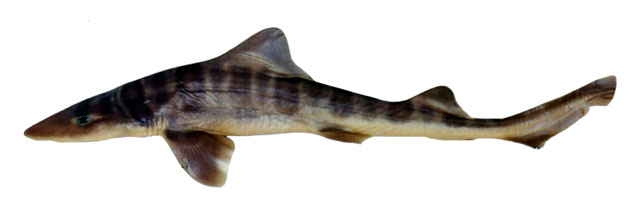
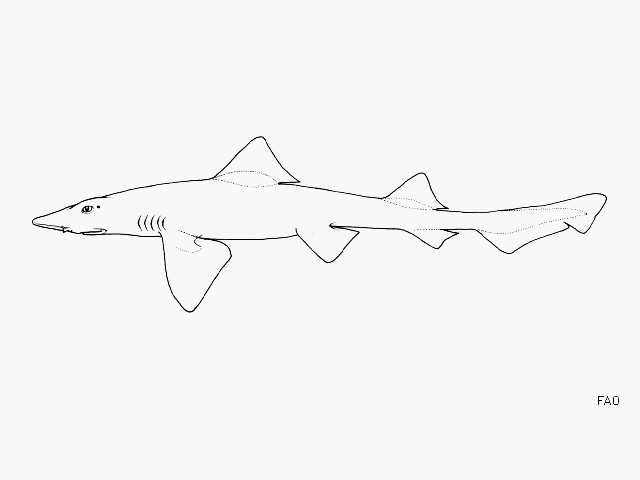
Striped smooth-hounds are coloured grey or brown-grey and sometimes black-spotted with a white underside. They have a relatively long snout and a flattened head. Their back is brown with narrow transverse bands of darker separated spaces. Striped smooth-hounds have a yellow spot in front of each eye, and their fins are dark with narrow edgings that are lighter.
They feed mainly on crustaceans such as shrimps and crabs.
Reproduction and Lifespan:
Striped smooth-hound sharks are ovoviviparous. Ovoviviparous animals reproduce by developing eggs inside the mother’s body, where the embryos hatch internally and are born as live young, nourished by the egg yolk rather than a placenta. Pregnant females migrate toward shallow waters to give birth between October and December. There are about four to 17 pups in a litter. At birth, the pups can be 39 cm/1.28 ft long, and they remain in the shallow waters.
Striped smooth-hounds can grow to a length of 150 cm/4.92 ft. Females mature at 111 cm/3.64 ft long, while males mature at 120 cm/3.94 ft. The oldest reported age was 24 years.
Conservation and Tourism:
Habitats of striped smooth-hound sharks are heavily fished in southern Brazil. Fisheries in the nursery area for these sharks catch pregnant females when they migrate near the shore.
In the 1980s, newly born sharks were caught in large numbers in gillnets off the beach, but by 2003, the number of sharks caught drastically decreased. The decline in newborn striped smooth-hound sharks is a clear indication that they are nearing extinction in Brazilian waters.
In Brazil, trawl fishing at depths of less than 10 m/32.8 ft is illegal, but enforcement of this law is lacking since trawling in the nursery area for Striped Smooth-hound sharks is met without almost any restrictions.
It is captured in intense and largely unmanaged commercial and artisanal demersal trawl, gillnet, and beach seine fisheries throughout its range. There are two population reduction estimates from research trawl surveys: (1) the southern Brazilian shelf; and, (2) the Argentina-Uruguay Common Fishing Zone. First, on the southern Brazilian shelf, catches of adults in research trawl surveys declined by 95% between 1981 and 2005, equivalent to a >99% population reduction over three generation lengths (43.5 years). Second, in the coastal region of the Bonaerensean District of northern Argentina and Uruguay, the biomass of this shark in trawl surveys decreased by 96% between 1994 and 1999, also equivalent to a >99% reduction over three generations. Due to the level of intense and largely unmanaged fishing pressure across its range, combined with its relatively unproductive life history, and noted declines, it is suspected that the Striped Smoothhound has undergone a population reduction of >80% over the past three generations (43.5 years), and it is assessed as Critically Endangered A2bd.
This species is listed in the Brazilian Ordinance of Ministry of the Environment No. 445, which restricts all harvest and trade of species listed as Endangered or Critically Endangered on the Brazilian National Red List (Feitosa et al. 2018, Vooren et al. 2018). This legislation came into force in December 2014, however, it was suspended for all of 2015 and the first half of 2016 due to pressure from the fishing industry (Begossi et al. 2017). The ordinance faces increasing industry pressure, including a court challenge to suspend the legislation again, by the Secretaria Nacional de Aquicultura e Pesca (SAP), who brought forward their contention that the Brazilian National Red List was designed specifically for terrestrial species (Spautz 2019). There are no species-specific protections or conservation measures in place in Uruguay or Argentina. To conserve the population and permit recovery, a suite of measures will be required which will need to include species protection, spatial management, bycatch mitigation, and harvest management, all of which will be dependent on effective enforcement. Further research is needed on life history and population size and trend, and species-specific monitoring should be undertaken in both commercial and artisanal fisheries.
Do you have images or videos of Striped Smooth-hounds?
Submit them to [email protected].


Donate Now | Team Sharkwater Newsletter | Group Sales | Shark Database | #SharkFree
Contact Us | Press | Partners | Terms of Use | Privacy Policy
© 2026 Sharkwater Productions - The Truth Will Surface 🦈