


The Taiwan Angelshark is found only in the waters around Taiwan and Japan. Their scientific name comes from the traditional name for Taiwan, Formosa. This species is categorized as endangered by the IUCN as they suspect there has been a reduction of between 50% and 80% of the population. Whilst they are not specifically sought after, they are particularly susceptible to getting caught by trawlers due to their bottom-dwelling nature.
Like other Angelsharks, the Taiwanese variety is an ambush predator. They lie still on the ocean floor, buried in the sand, and wait until their prey is in reach before striking. They are usually found at depths between 100 and 300 meters/328 and 984 ft.
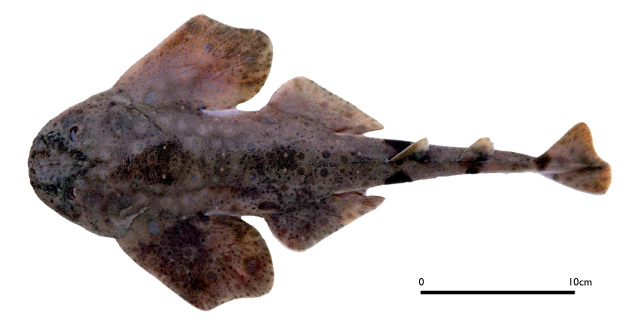
They have flat, widebodies, which is a feature of all Angelsharks. They are dark in colour on the dorsal side but their abdomens are much paler, almost white. This little-known species is thought to be fully grown at around 1-2 meters/3.3–6.6 ft.
The species is taken as bycatch in demersal trawl, and possibly gillnet and longline fisheries, and is retained for the meat and fins, and fish meal. There are no species-specific population trends. It is observed in low numbers at landing sites with this abundance little changed over the past 17 years, although there is no concurrent effort data from the area of the sites to infer population trends. Landings data of all sharks combined from the Taiwan Exclusive Economic Zone (EEZ) infer a reduction of 55% in the Taiwan Angelshark over the past three generation lengths (69 years). Squatina spp. have declined dramatically where they have been intensively fished elsewhere which is evidence that Squatina spp. are unable to sustain intense fishing pressure. It is inferred that the Taiwan Angelshark has undergone a population reduction of 50–79% over the past three generation lengths (69 years) due to high levels of exploitation across its entire range, and it is assessed as Endangered A2d.
There are no species-specific conservation measures in place. In Taiwan, since 1999, all demersal trawling is prohibited within three nautical miles (nm) of the coast and within 12 nm for trawlers larger than 50 Gross Registered Tonnage (Fisheries Agency 2019, Liao et al. 2019). Since 2005, shark fins must be naturally attached on vessels that use ice to preserve the catch (Fisheries Agency 2019, Liao et al. 2019).
To conserve the population and to permit recovery, a suite of measures will be required which may include species protection, spatial management, bycatch mitigation, and harvest and trade management measures (including international trade measures). Effective enforcement of measures will require ongoing training and capacity-building (including in the area of species identification). Catch monitoring is needed to help understand population trends and inform management.
Do you have images or videos of Taiwan Angelsharks?
Submit them to [email protected].


Donate Now | Team Sharkwater Newsletter | Group Sales | Shark Database | #SharkFree
Contact Us | Press | Partners | Terms of Use | Privacy Policy
© 2026 Sharkwater Productions - The Truth Will Surface 🦈