


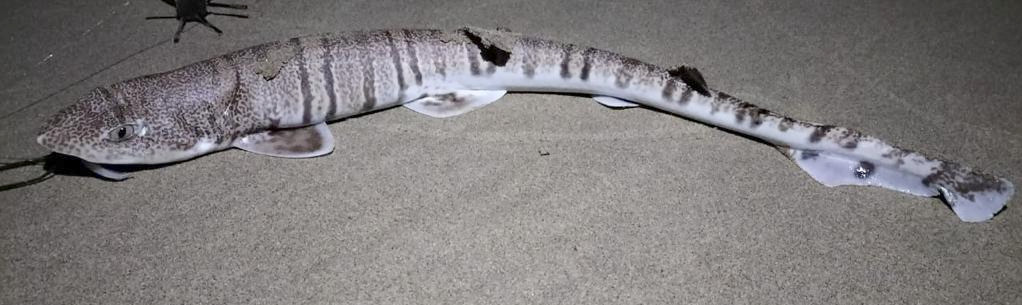
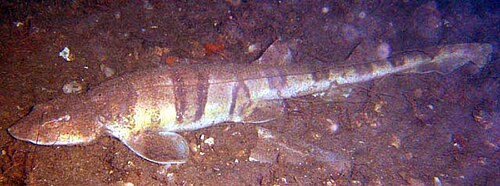
Tiger catsharks are found in the southern African continental shelf off South Africa and Mozambique.
These sharks occur on or near the bottom from close inshore to 172 m/564 ft. The individuals found offshore were mostly adults. Offshore records from the Eastern and Western Cape are from 30 to 90 m/98–295 ft of depth.
It is oviparous and lays 6 to 11 per litter. The feed primarily on small bony fishes and crustaceans.
It is a discarded bycatch of demersal trawl, longline, beach seine, gillnet, and squid fisheries, and is not known to be utilized or traded. Trend analysis of research trawl data in South African commercially fished areas estimated a population reduction of 67% over three generation lengths (45 years), with the highest probability of 50–79% reduction over three generation lengths. This reduction is driven partly by a steep decline in catches during the early 1990s when fishing pressure in South Africa was substantially higher. Climate change likely contributed to a range shift away from the research trawl grounds that may account for some of the estimated population reduction but that also likely represents a significant loss of habitat for the Tiger Catshark. Overall, due to an estimated population reduction over most of its range and a substantial reduction in fishing effort in South Africa, combined with a suspected range shift due to climate change that could account for some of the estimated reduction but also likely represents a decline in area of occupancy, it is suspected that the Tiger Catshark has undergone a population reduction of 30–49% over the past three generation lengths (45 years), and it is assessed as Vulnerable A2bcd.
There are no species-specific protections or conservation measures in place for this species. Recreational anglers in South Africa are restricted to one shark per species per day (maximum of 10 individuals per day) (da Silva et al. 2015), although enforcement is an ongoing issue. A number of Marine Protected Areas (MPAs) occur across its range, including: iSimangaliso MPA and the uThukela MPA in South Africa, and Ponta do Ouro Partial MPA in southern Mozambique. Further research is needed on population size and trends, life history, and catch rates.
Do you have images or videos of Tiger Catsharks?
Submit them to [email protected].


Donate Now | Team Sharkwater Newsletter | Group Sales | Shark Database | #SharkFree
Contact Us | Press | Partners | Terms of Use | Privacy Policy
© 2026 Sharkwater Productions - The Truth Will Surface 🦈