


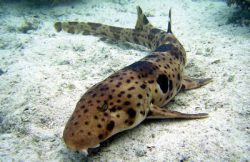
Henry’s Epaulette Shark is a species of carpetshark found in West Papua, Indonesia, at depths of between 3m and 30m/9.8–98.4 ft. They are thought to be nocturnal and although they are usually found resting on the ocean floor, they have been observed swimming or ‘walking’ slowly across the sand, a common behaviour of the Hemiscyllium genus.
There is no information on the biology of the Triton Epaulette Shark. They grow to a maximum total length of 81.5cm/2 ft 8.1 in and are possibly the largest species in the genus.
It is threatened by artisanal fisheries exploitation, as well as habitat degradation due to coastal development and climate change across most of its geographic range. The area of occurrence for this species is ~1,148 km²/443.25 sq mi and it occurs in six locations with continuing intensive fishing pressure and declines in area, quality of habitat, and number of mature individuals. This species has some protection against habitat loss and degradation with four of its known locations occurring within the Kaimana District Marine Conservation Area but fishing pressure is still very high in this region. Therefore, Henry’s Epaulette Shark is assessed as Vulnerable meeting criteria B2ab(ii, iii, v).
Henry’s Epaulette Shark is always retained when caught for artisanal and local consumption. Not generally sold or seen in fish markets. It is unknown if there is aquarium or ornamental collection and the value of individuals.
Henry’s Epaulette Shark is afforded some conservation protection over some of its known range (~25%) by three Marine Protected Areas (MPAs): Kaimana MPA (122,586 ha), Buruway MPA (240,493 ha) and Teluk Nusalasi Van Den Bosch (248,270 ha) – though enforcement is generally weak and there is no explicit protection for sharks. Moreover, the use of gillnets is very common over this species’ range. The Marine Protected Areas do prevent wholesale habitat destruction and commercial fisheries however. There is a growing marine tourism industry in the region that values this species as a tourism asset. Further research is needed on population size and trend, and life history, and catch rates should be monitored.
Do you have images or videos of Henry’s Epaulette Sharks?
Submit them to [email protected].




Donate Now | Team Sharkwater Newsletter | Group Sales | Shark Database | #SharkFree
Contact Us | Press | Partners | Terms of Use | Privacy Policy
© 2026 Sharkwater Productions - The Truth Will Surface 🦈