


The Tropical Sawshark is a species of sawshark, member of the family Pristiophoridae. It is endemic to northeastern Australia.
Biology and Description:
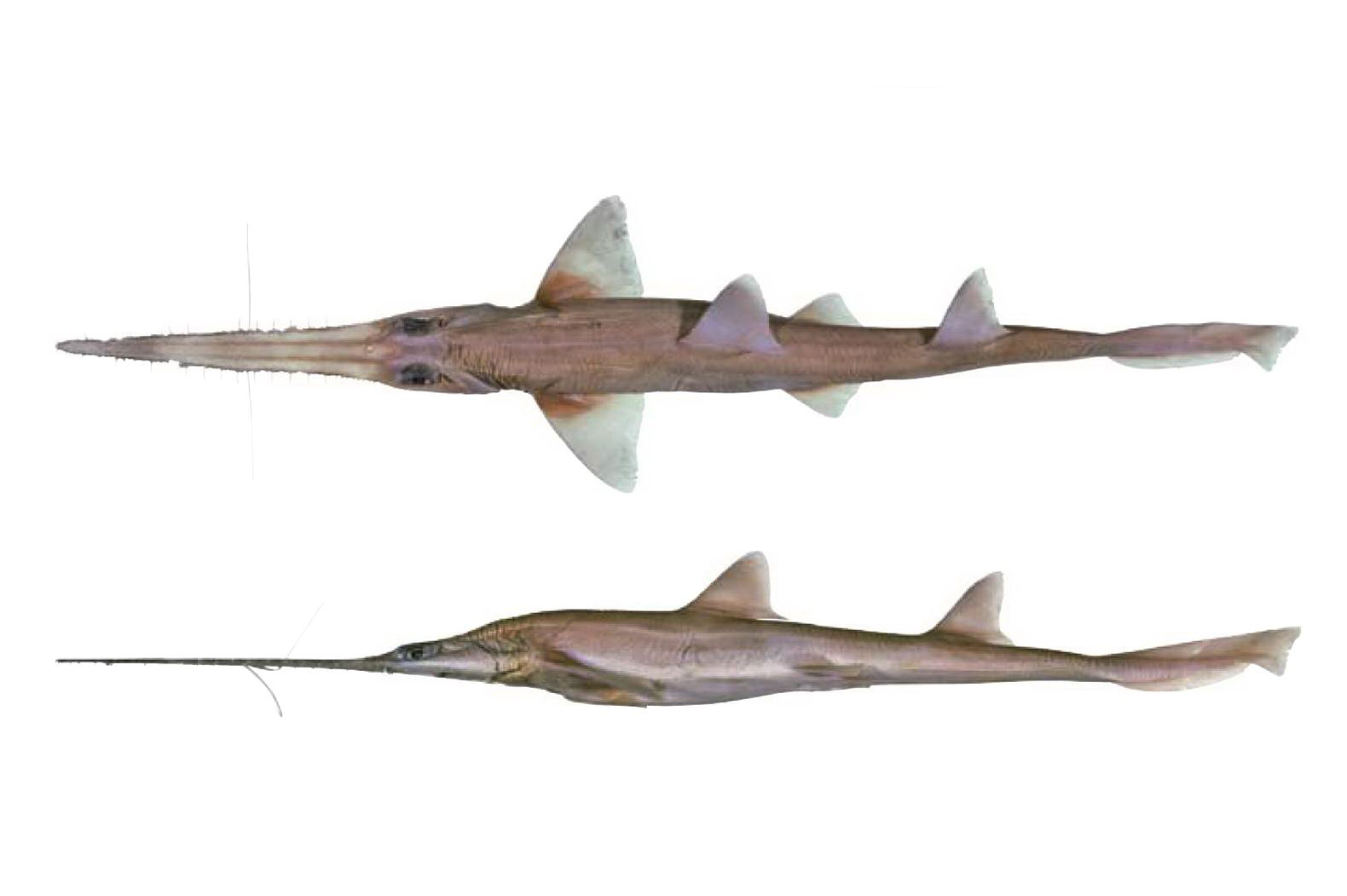
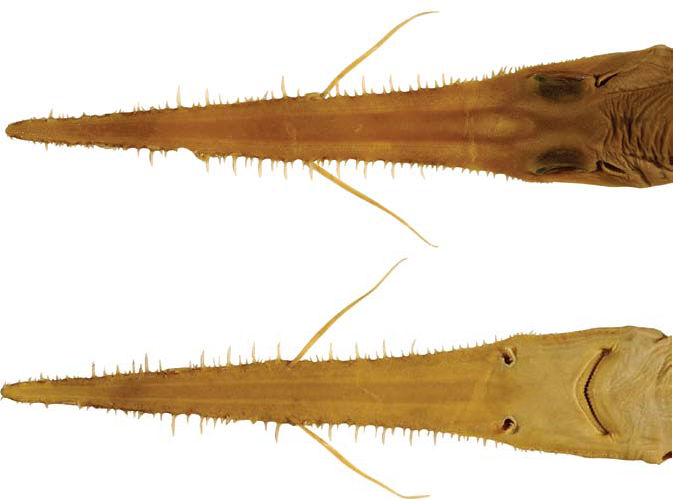
The Tropical Sawshark is a small species reaching a maximum size of 85 cm/2 ft 9.5 in TL for females and 63 cm/2 ft 0.8 in TL for males. Its body is slender with a circular cross-section and depressed forward of the gill slits. The elongated, saw-like snout tapers evenly to its tip and bears very slender lateral teeth of variable lengths. The eyes are large and oval in shape. The nostrils about a one-third the distance from the corner of the mouth to the barbel attachment on the rostrum. The mouth is large and arched, with 47 tooth rows in the upper jaw and 37 in the lower. The pectoral fins are large with narrowed rounded tips. The two dorsal fins are well separated, the first longer and broader than the second. The caudal fin is short, with the lower lobe absent. The coloration is medium brown above and white below. Biology information on this species is almost entirely unknown. It is ovoviviparous.
Habitat:
The Tropical Sawshark is a pelagic-oceanic species, found at depths of 246 to 405 m/807.1 to 1,328.7 ft. it occurs on the continental slope to a confined region in Northeast Australia between Gladstone and Cairns off the coast of Queensland.
Conservation:
There are currently no conservation measures in place for this species. The range of the species potentially overlaps with the Coral Sea Commonwealth Marine Reserve.
It has been captured as bycatch in the Queensland East Coast Trawl Fishery (deepwater component of the eastern king prawn sector), though this sector has low fishing effort and generally does not operate within the depth range of this species. The Queensland commercial deepwater line fishery and some recreational fishers and charter operators may interact with this species, though no captures have been reported. The Commonwealth-managed Coral Sea Fishery also operates within the species’ area of occurrence, however there has been no trawl effort in nearly 10 years. Although a poorly-known species, its distribution is subject to only minimal fishing effort, and it is likely to receive refuge at depth. It is therefore assessed as Least Concern, however, bycatch levels should be monitored and any future expansion of demersal trawling within its range (which is unlikely) may pose a risk given its limited geographic and bathymetric range.
Do you have images or videos of Tropical Sawsharks?
Submit them to [email protected].


Donate Now | Team Sharkwater Newsletter | Group Sales | Shark Database | #SharkFree
Contact Us | Press | Partners | Terms of Use | Privacy Policy
© 2026 Sharkwater Productions - The Truth Will Surface 🦈