


The Velvet Dogfish is a deepwater shark species found in the Atlantic, Indian and Pacific tropical oceans. Generally, on or near the bottom of continental and insular slopes at depths of 550 to 1,450 metres, this species can also be found at the surface to 2,000 metres deep.
Biology:
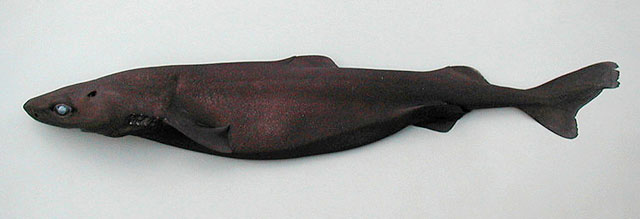
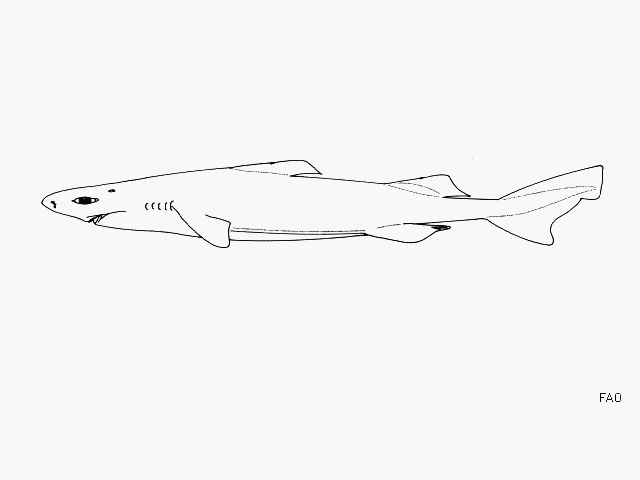
The Velvet Dogfish is a small and slender black dogfish species, has two small dorsal fin spines, a moderately long snout, small lanceolate teeth in their upper jaw and large, high cutting teeth in their lower jaw. Reaching a maximum total length of 69 cm, females mature at 59 cm while males mature at 49 cm. Little else is known of their biology.
Conservation:
The Velvet Dogfish may be subject to local variability in its susceptibility to capture and likely has refuge at depth. It is infrequently reported from surface longline, as well as demersal longline and trawl fisheries. The species is not suspected to be close to reaching the population reduction threshold. There is nothing to suspect or infer population reduction at this time, and the Velvet Dogfish is assessed as Least Concern.
There are no species-specific measures in place for the Velvet Dogfish. Targeted deep-water shark fishing is not permitted in the South East Atlantic Fisheries Organization (SEAFO) Convention Area or under the Southern Indian Ocean Fisheries Agreement (SIOFA) (SIOFA 2019, SEAFO 2016). The species is considered a “key species of concern” within the SIOFA area (SIOFA 2019). Further information is required on its distribution, ecology and life history, and interactions with fisheries.
Do you have images or videos of Velvet Dogfishs?
Submit them to [email protected].


Donate Now | Team Sharkwater Newsletter | Group Sales | Shark Database | #SharkFree
Contact Us | Press | Partners | Terms of Use | Privacy Policy
© 2026 Sharkwater Productions - The Truth Will Surface 🦈