


Whiskery Sharks are endemic to southern and western Australia and northern Tasmania at depths of 220 m (722 ft) near the bottom of the sea floor. They favour rocky areas and kelp beds.
Biology and Behaviour:
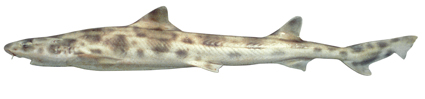
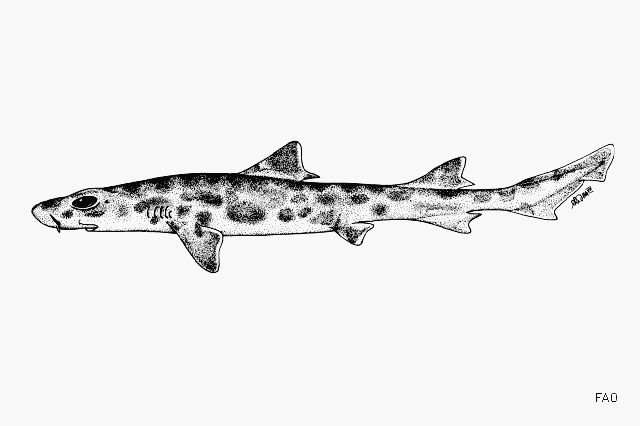
They are stout-bodied and almost hump-backed in form. The whiskery shark can be distinguished from all other members of its family by the presence of long nasal barbels (a slim whisker-like organ near the mouth). Its two moderately large dorsal fins are similar in size.
They have a short, rounded snout, and horizontal oval eyes with nictitating membranes. They have five pairs of gill slits.
Their diet primarily consists of octopuses, but they will also eat cephalopods, bony fish, small rock lobsters, spoon worms and seagrass.
Reproduction and Lifespan
Whiskery sharks are ovoviviparous, and females have between four to 28 pups every other year with an average of 19 pups. Female whiskery sharks gestate for about seven to nine months. At birth, young whiskery sharks are 22 to 27 cm (8.7–10.6 in) long. Pups grow fast wherein 15 to 17 months they grow to be three times larger than their initial size. The age of maturity is approximately four years for males and about six years for females. Ovoviviparous animals reproduce by developing eggs inside the mother’s body, where the embryos hatch internally and are born as live young, nourished by the egg yolk rather than a placenta.
The maximum lifespan is presumably to be 15 years. They grow to a maximum of 160 cm/5.25 ft long.
Conservation and Tourism
The IUCN lists Whiskery Sharks as least concern as the population has been stable for about 30 years.
They are abundant in southwestern Australia where it is a targeted species in demersal gillnet fishery.
It was mainly caught in Australia during the 1970s and 1980s, so their population significantly decreased due to overfishing which led to a strict new regulation. Since the implementation of the regulation, it has helped increase and stabilizes their population.
The Whiskery Shark is targeted within the Western Australian Temperate Demersal Gillnet and Demersal Longline Fishery, where high levels of historic exploitation reduced populations to as low as 45.4% of unfished biomass in 1996–1997. Since then, a suite of management measures have been put in place to ensure recovery and ongoing take at sustainable levels. In 2009–2010, a modest increase to 52.1% of virgin biomass was estimated, and catch rates have been increasing from ~2010–2020 indicating ongoing recovery. This species is also caught in low levels across a range of sectors in the Commonweatlh Southern and Eastern Scalefish and Shark Fishery. Most catch occurs in the Gillnet Hook and Trap sector Shark Gillnet sub-fishery, where effort has been reduced by ~45% from 2003–2024. Over the past three generation lengths (27 years), there may have been some initial ongoing decline that was arrested and followed by an increase in biomass due to large fisheries effort declines and strict quota management. Therefore, at the current time, the Whiskery Shark is assessed as Least Concern.
Management measures in the Western Australian Temperate Demersal Gillnet and Demersal Longline Fishery are in part aimed at ongoing population rebuilding of the Whiskery Shark, which is one of four main target species. These measures include effort controls, mesh size restrictions, and spatial and temporal closures (Braccini et al. 2021a, Watt et al. 2021). The Whiskery Shark would also receive some refuge from the various marine protected areas in state waters and in the Australian Commonwealth Marine Park network that partly overlaps with its range, which includes zoning and gear restrictions (Parks Australia 2024). In 2021, the national Red List status of this species was Least Concern and in 2023, the stock was assessed as Sustainable (Kyne et al. 2021, Simpfendorfer and Rigby 2023). Ongoing monitoring of population size and trend, and catch rates is required.
Do you have images or videos of Whiskery Sharks?
Submit them to [email protected].



Donate Now | Team Sharkwater Newsletter | Group Sales | Shark Database | #SharkFree
Contact Us | Press | Partners | Terms of Use | Privacy Policy
© 2026 Sharkwater Productions - The Truth Will Surface 🦈