


The Whitefin Swellshark is a species of catshark, belonging to the family Scyliorhinidae, endemic go Southeastern Australia.
Biology and Description:
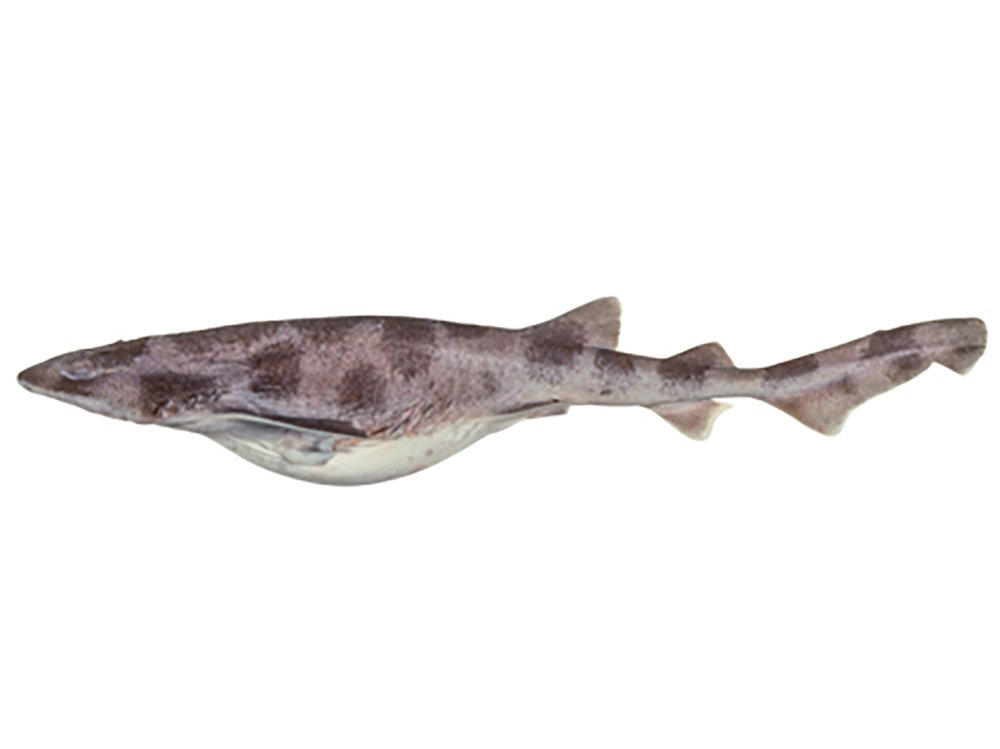
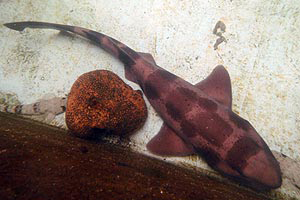
The Whitefin Swellshark is a stocky species measuring up to 1.1 m/3.61 ft long. The head is short, wide and flattened with a rounded snout. The eyes are positioned high on the head followed by tiny spiracles. The mouth is large and arched and the nostrils are preceded by expanded skin flaps. There are around 90-116 upper tooth rows and 97-110 lower tooth rows; each tooth has three central cusps. The first dorsal fin is rounded and originates over the pelvic fin. The second dorsal fin is much smaller and triangular, originated over the anal fin. The pelvic fins are small, males have long claspers. The large caudal fin has a distinct lower lobe and a deep ventral notch near the tip. Like other members of its genus, the Whitefin Swellshark can swallow water or air to increase its girth as a defence against predators. Its reproduction mode is oviparous; the eggs are enclosed in smooth flask-shaped capsules. Maturity in males and females is reached at 70 cm/2.3 ft and 98 cm/ 3.22 ft respectively. Males reach maximum size at 101 cm/3.31 ft TL and females at 102.5 cm/3.36 ft TL.
Habitat:
The Whitefin Swellshark is found off southeastern Australia from Batemans Bay, New South Wales as far as Western Australia, including Tasmania. It is a bottom dweller that inhabits the outer continental shelf and the upper continental slope at a depth of 126 – 554 m (413–1,818 ft).
Conservation:
It is a common component of bycatch in trawl fisheries, with small amounts being retained for marketing. The entire geographic and depth range of this species has been subjected to intensive trawling over several decades, with fishing effort ongoing. Population reductions based on genus-level catch data have been documented on the New South Wales upper slope (32% reduction over 20 years; the equivalent of a 58% population reduction over three generations (45 years)) and for a broader area of the Southern and Eastern Scalefish and Shark Fishery (SESSF) which operates across the species’ geographic and depth range. Standardized catch-per-unit-effort in the SESSF decreased by 73% over the period 1994 to 2006, and given that this trawl fishery has been in place for decades before any data on abundance was available as well as the declines documented off New South Wales, it is reasonable to expect that a similar decline rate occurred previously. This decline is the equivalent of a ~99% population reduction over the past three generations (45 years). Overall, it is inferred that the Whitefin Swellshark has undergone a population reduction of >80% over the past three generations, and it is therefore assessed as Critically Endangered A2bd.
There are no specific conservation actions for this species. There are general conservation measures for other deepwater sharks off southeastern Australia, including spatial closures for gulper sharks (Centrophoridae), that have the potential to benefit this species. The species may also benefit from closed areas in the Australian Marine Park Network. Bycatch mitigation, and potentially spatial management, is required to allow the population to recover.
Do you have images or videos of White-fin Swellsharks?
Submit them to [email protected].


Donate Now | Team Sharkwater Newsletter | Group Sales | Shark Database | #SharkFree
Contact Us | Press | Partners | Terms of Use | Privacy Policy
© 2026 Sharkwater Productions - The Truth Will Surface 🦈