


The whitespot smoothhound is endemic to southern African waters. They are active offshore only and caught from the intertidal to 611 m/2,005 ft.
Whitespots are found in shallow subtidal sandy beaches and reefs. It feeds on octopus, crustaceans and bony fish. The maximum size a male could go is 120 cm/3.94 ft, the size of the female is unknown. Born at 25 cm/9.8 in, they are viviparous, and the size of a litter is 3 to 15.
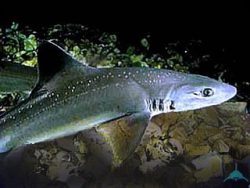
They’re caught as a bycatch by commercial trawl fisheries off the south and west coasts of South Africa. They usually have lines or scatterings of small white spots along the body and grey above, white below.
Species- specific data is not available but indications from demersal fish biomass assessment that cruises off South Africa state that Mustelus species could be declining. Despite the common status and that it appears to be in habitats which are untrawlable, there are other concerns like fishing developments which happens to reduce its number. As much data isn’t available on the population, further research is necessary, and bycatch should be noted at the species level.
This species is taken as bycatch in demersal trawl, line, and gillnet fisheries, and by recreational fishers, and may be discarded or retained for the meat and fins. In South Africa, trend analysis of research trawl surveys in fished areas over 27 years from 1991 to 2017 indicate a population increase over the past three generation lengths (42 years). Fishing pressure is suspected to be lower in Namibia and although fishing pressure is likely intense in Mozambique, this only represents a small portion of the species’ range. Overall, due to the estimated increase in population over most of its range (i.e. South Africa), but acknowledging some possible intense fishing pressure in a small part of the range, the population trend is suspected to be stable over the past three generation lengths (42 years), the Whitespot Smoothhound is not suspected to be close to reaching the population decline threshold, and it is assessed as Least Concern.
There are no species-specific protections or conservation measures in place. Recreational anglers in South Africa are restricted to one shark per species per day (maximum of 10 individuals per day) (da Silva et al. 2015), although enforcement is an ongoing issue. A number of protected areas occur across its range, including: the West Coast National Park, the iSimangaliso Marine Protected Area (MPA), and the uThukela MPA in South Africa, and Ponta do Ouro Partial MPA in southern Mozambique. Further research is needed on population size and trend, and life history, and catch rates should be monitored.
Do you have images or videos of White-spotted Smooth-hounds?
Submit them to [email protected].


Donate Now | Team Sharkwater Newsletter | Group Sales | Shark Database | #SharkFree
Contact Us | Press | Partners | Terms of Use | Privacy Policy
© 2026 Sharkwater Productions - The Truth Will Surface 🦈